Strategic Context
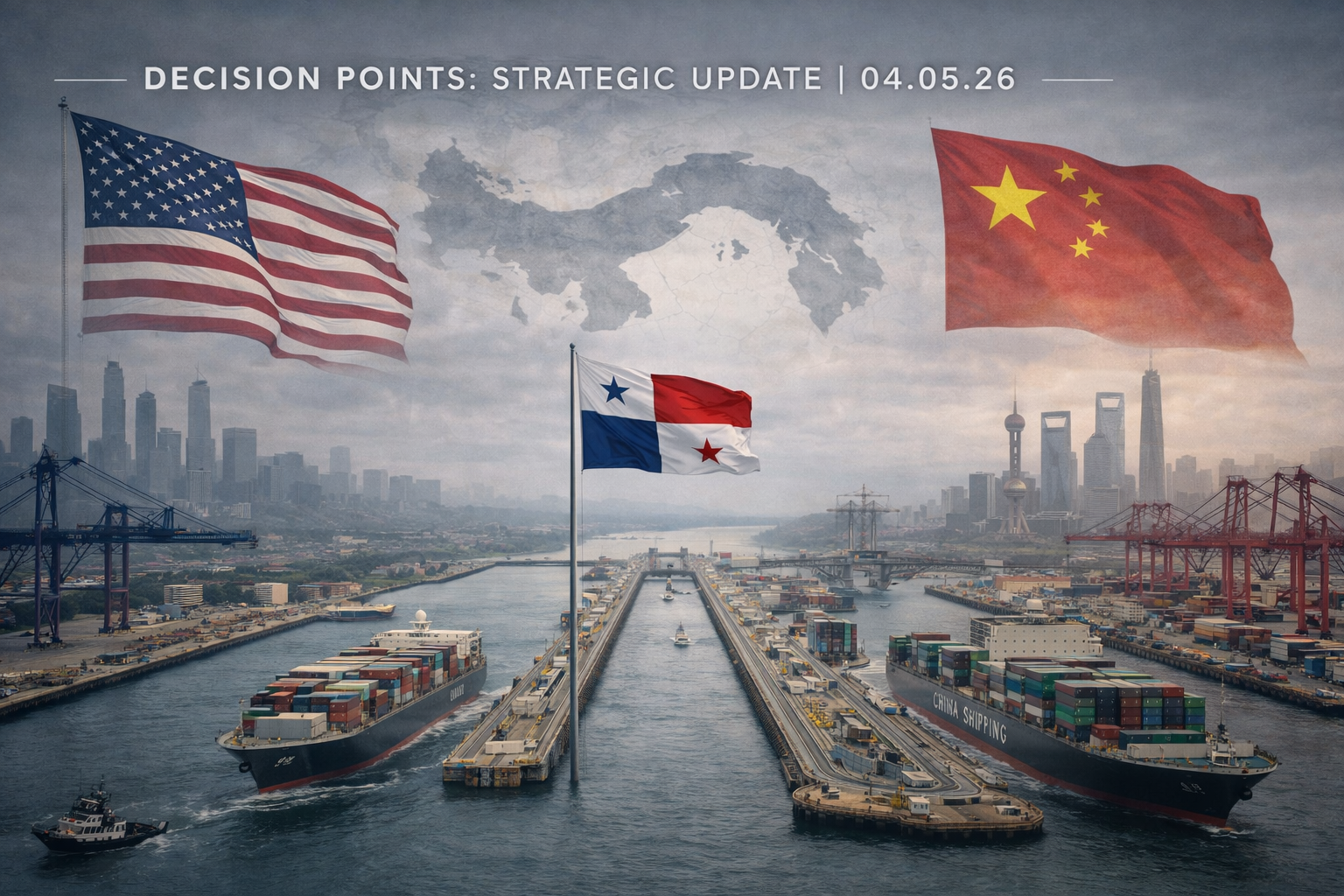
The past week was defined by the expansion of strategic risk around maritime chokepoints. In Panama, a dispute that began over port concessions and sovereignty has widened into a more explicit contest over shipping, legal jurisdiction, and Chinese leverage around the canal. In the Red Sea and Horn of Africa, the Houthis’ entry into the wider regional war has sharpened concern around Bab el-Mandeb just as Sudan’s conflict continues to radiate instability across the western side of the same corridor. These are not isolated stories. They point to a broader pattern: infrastructure that underpins trade is becoming a site of coercion, not just commerce.
Key Takeaways
1) Panama is caught in the middle of U.S.-China coercive competition.
The most important strategic development in the Americas this week was in Panama. Panama’s Supreme Court just invalidated a 1997 concession that gave CK Hutchison Holdings control over two key ports at either end of the canal. CK Hutchison moved to arbitration, but more importantly, the PRC has reportedly started to detain Panama-flagged ships when they enter Chinese waters.
That shifts this beyond a legal dispute over concessions. It becomes a test of whether Beijing can impose costs on countries that move to unwind Chinese-linked control over strategic infrastructure.
Because Panama’s flag is used across global shipping, it may creates delays and costs for a wide range of international vessels, turning a local dispute into something that touches the broader trade system.
Why it matters: The Panama Canal remains one of the hemisphere’s most strategically important trade arteries. If Panama starts to absorb economic pressure through its shipping registry or canal-linked commercial ecosystem, the message to smaller states is clear: infrastructure disputes with China can be made expensive even without a formal sanctions regime. That is a more flexible and politically deniable form of coercion.
2) Honduras leans away from China
Honduras is reconsidering its 2023 decision to switch diplomatic recognition from Taiwan to China. President Nasry Asfura is weighing a reversal, with Vice President María Antonieta Mejía confirming a review of economic agreements with Beijing as Tegucigalpa explores renewed ties with Taipei.
That suggests the expected economic benefits from aligning with China may not be materializing as planned. Rather than a permanent geopolitical shift, recognition is being treated as contingent on delivery.
Why it matters: If countries begin to revisit or hedge these decisions, China’s diplomatic gains become less durable than assumed. Recognition shifts stop being one-way moves and instead become leverage, increasing competition with Taiwan and introducing more fluidity into alignment decisions in Central America.
3) The Houthis turned the Red Sea back into an immediate strategic risk this week
The Houthis resumed missile attacks on Israel this week, raising fresh concern that Red Sea shipping could be disrupted again, pushing vessels to reroute around Africa instead of using the Suez Canal.
Why it matters: The strategic issue is not only whether the Houthis can sink additional ships or temporarily raise freight costs. It is that Suez Canal shipping route is once again exposed to disruption at the same time that companies are leery of transiting the Straits of Hormuz. That leaves the system with less room to absorb another shock. If attacks intensify, more vessels will divert, extending transit times and raising costs across routes that are already under pressure.
4) Sudan gives the Red Sea story a western shore, which makes this more than a Yemen problem
Sudan’s civil war remains one of the least appreciated strategic risks in the region because it is still treated primarily as a humanitarian crisis rather than a corridor problem. But the real issue is control over access to Sudan’s Red Sea ports, particularly Port Sudan, and the internal routes that connect them to the rest of the country.
This week’s violence, including an RSF drone strike on a hospital in White Nile state reported on April 3, reinforces that the conflict remains active, fragmented, and expanding in capability. External actors, including Saudi Arabia and the UAE, are tied to the growing use of drone strikes, increasing both the range and frequency of attacks.
Why it matters: This is no longer just a civil war. It is a fight over access to the Red Sea. Yemen is already threatening shipping from the water. Sudan introduces risk from the land side, where control over ports and supply routes is still contested. The Red Sea is vulnerable not because of one actor, but because instability now exists on both shores.
What to Watch
Watch whether countries like India and Indonesia begin leaning more heavily on U.S. energy supply if Red Sea disruption intensifies. These states have spent the past few years balancing between Beijing and Washington. That becomes harder to do when fuel is scarce. China is not in a position to backstop fuel supply for the region, while the U.S. remains the only actor with the capacity and flexibility to step in at scale. Indonesia has previously looked to China to help expand its refining capacity. Turning to the U.S. now for fuel supply would solve an immediate problem, but it could strain Indonesia’s relationship with China.