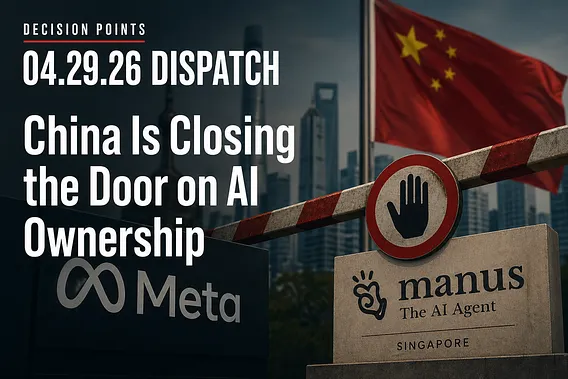
On Monday, China’s top economic planner stepped in to block Meta Platforms from acquiring Manus, an AI startup with Chinese roots that had relocated to Singapore, ordering the $2 billion deal to be unwound. On its face, it looks like a regulatory intervention. In practice, it cuts directly at a model that had quietly become standard in the AI ecosystem. Chinese-founded companies would move offshore, raise foreign capital, and repackage themselves as global businesses, allowing both investors and founders to sidestep tightening controls in Beijing and Washington.
Manus fits that pattern almost perfectly. It was founded in China, moved to Singapore, attracted U.S. venture backing, and built products at the edge of general-purpose AI. But none of that proved enough to put it outside Beijing’s reach. The underlying logic has shifted. AI is no longer treated as just another sector, but as infrastructure tied to national capability, where talent, intellectual property, and control are not meant to move freely across borders.
What this episode makes clear is that location is no longer the deciding factor. A company can relocate, restructure, and raise capital abroad, but if its origins, capabilities, or talent base remain tied to China, it is still likely to be treated as part of that system. The idea that you can simply “move” an AI company out of China and make it global is starting to break down.
The implications are broader than a single blocked deal. For investors, it raises the risk that cross-border transactions in AI can be unwound after the fact. For founders, it narrows the set of viable exit paths. And for the industry as a whole, it points toward a more fragmented landscape, where the flow of capital and control is shaped less by market logic and more by national boundaries.