
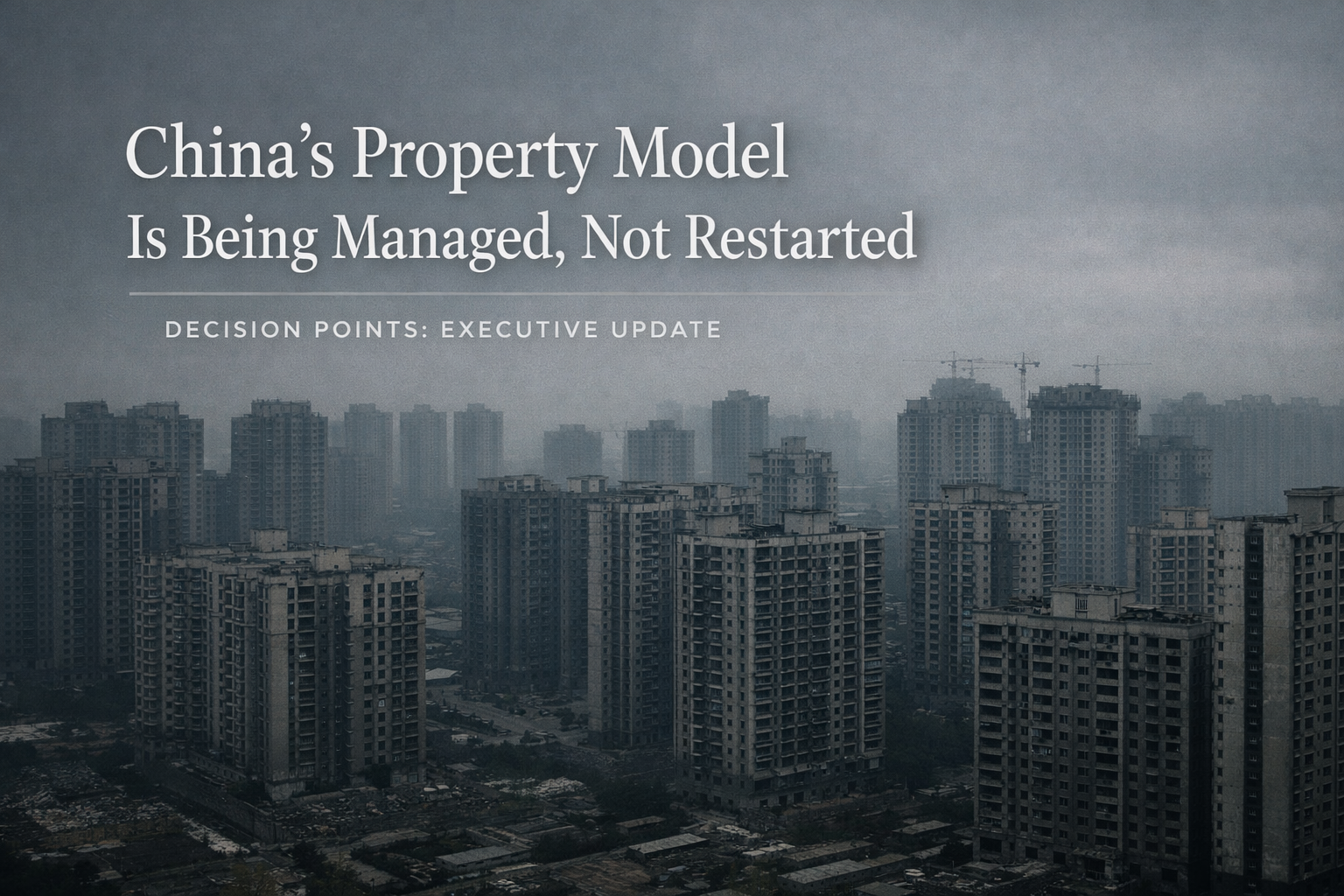
China’s property sector developed into a central component of its economic model over several decades.
Following the country’s economic reforms in the late 20th century, real estate became one of the primary channels for growth. Developers financed expansion through debt and pre-sales, local governments relied heavily on land sales to generate revenue, and households increasingly concentrated their savings in property. This structure created a system where construction, credit, and demand reinforced each other.
The model remained stable as long as prices continued to rise and new demand absorbed supply.
Over time, however, leverage accumulated across the system. Developers became dependent on continuous access to financing, and the sustainability of the sector relied on maintaining expansion rather than managing risk.
By the late 2010s, Chinese policymakers began to view this as a structural vulnerability.
In 2020, regulators introduced a series of financial constraints on property developers designed to limit leverage and reduce systemic risk. These measures restricted access to credit and marked a shift away from the expansion-driven model that had defined the sector.
The effects of these policies developed gradually.
As financing conditions tightened, developers began to encounter liquidity constraints. Construction slowed, and in some cases projects were left incomplete. This began to affect buyer confidence, particularly in a system that relied heavily on the pre-sale of unfinished properties.
Over time, this introduced a feedback loop. Lower sales reduced developer cash flow, which delayed project completion. Delays further weakened buyer confidence, contributing to additional declines in demand.
The resulting slowdown was not limited to the property sector itself.
Real estate activity had been a major driver of demand for materials such as steel, cement, and copper. It also played a central role in local government finances through land sales. As activity slowed, these effects began to extend into other parts of the economy.
Policy responses since that point have focused on stabilizing the system rather than restoring the previous model.
Authorities have introduced targeted measures to support financing, ensure project completion, and prevent broader financial contagion. Banks have been encouraged to extend lending where necessary, and local governments have taken a more active role in managing distressed projects.
At the same time, the underlying constraints on leverage have not been fully reversed.
This reflects a change in policy. Rather than attempting to restart the property sector as a primary engine of growth, Chinese policymakers are now focused on managing its contraction in a way that preserves stability. The goal is to limit disorder, maintain confidence, and prevent systemic risk from spreading through the financial system.
The current situation reflects the adjustment of a model that was built on continuous expansion under conditions that no longer exist.
The sector is not being restarted. It is being contained.
Recent reporting suggests that this process is still ongoing. New home prices have continued to decline into 2026, reflecting persistent weakness in demand and limited confidence in the sector. Property activity had been a major driver of demand for materials such as steel, cement, and copper, while also supporting local government finances through land sales. As activity slowed, these effects began to move through the broader economy. The Atlantic Council believes that this is no longer being treated as an isolated real estate issue, but as a broader economic drag.
Authorities have introduced targeted measures to support financing, ensure project completion, and prevent broader financial contagion. There are also indications that some earlier constraints may be adjusted at the margin, including discussion around easing elements of the “three red lines” policy.
This has led to some divergence in how the current phase is being interpreted.
Some commentary frames the current environment as a “reset,” reflecting the cost of unwinding the previous model. Others point to signs of stabilization, but at lower levels of activity rather than a return to prior growth.
Broader economic data is beginning to reflect this shift as well, with growth showing signs of pressure tied in part to weakness in the property sector.
As activity in the property sector slows, investment is shifting into other areas of the economy, particularly manufacturing, infrastructure, and advanced technologies, as policymakers look for alternative sources of growth to replace the role that real estate once played. At the same time, they are working to limit the risks coming out of the property sector, not by reversing the earlier constraints, but by managing the pace of its decline while continuing to support areas of the economy that are expected to carry growth moving forward.







Leave a Reply